
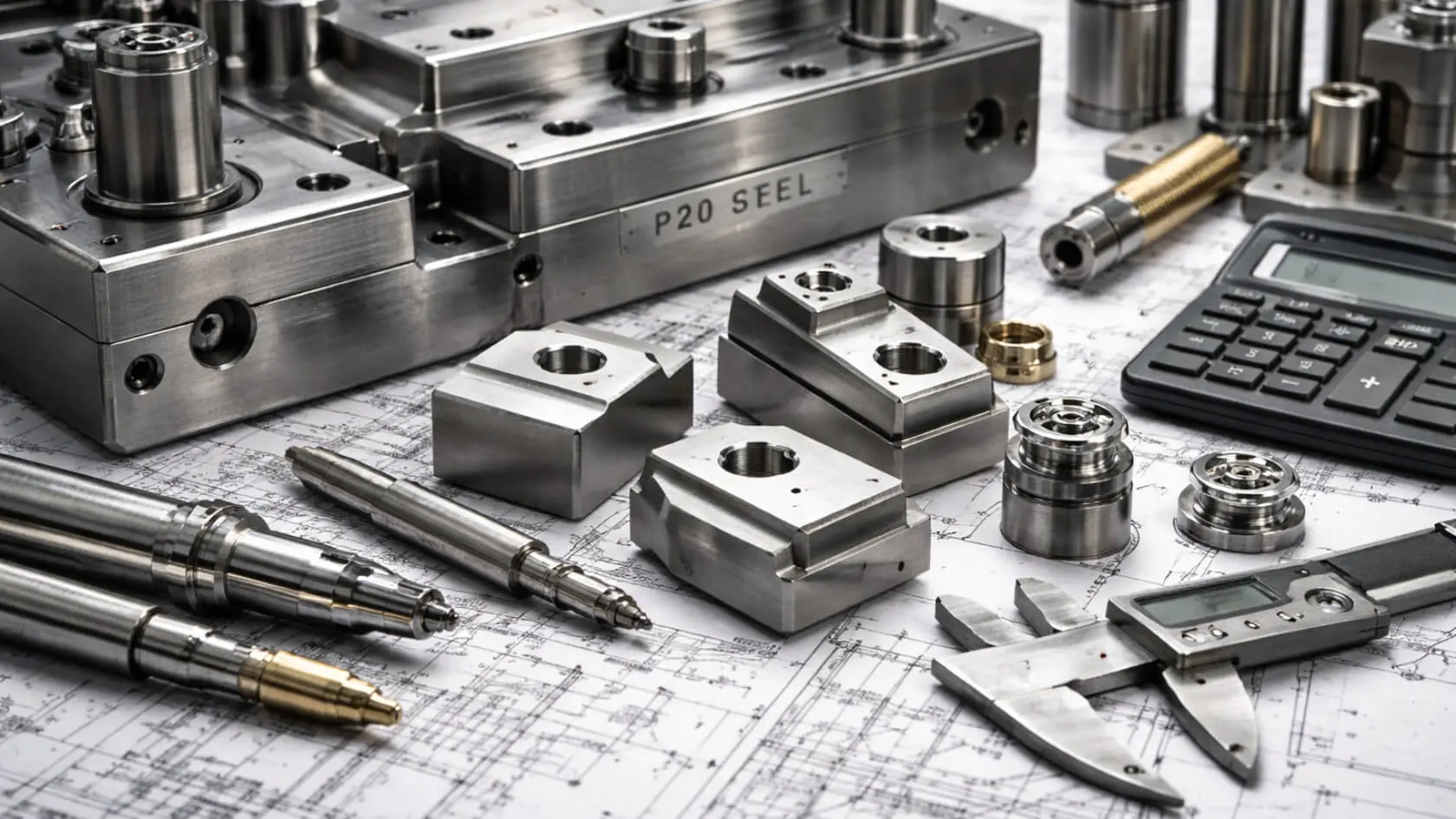
When sourcing an injection mold, one of the first questions is:
“Why does the price vary so much?”
A transparent cost breakdown helps avoid unexpected tooling revisions and production delays.
Injection mold pricing is not arbitrary. It is determined by a combination of engineering complexity, material selection, machining time, precision requirements and project risk.
Understanding these factors helps buyers make informed decisions and avoid unexpected cost increases later in production.
Part Complexity and Geometry
The geometry of the plastic part directly impacts mold cost.
Key drivers:
- Undercuts and side actions
- Thin wall structures
- Deep ribs or complex core designs
- Tight tolerances
- Surface texture requirements
Complex geometries require additional machining hours, precision inserts, and sometimes multi-slide mechanisms.
More moving components = higher tooling cost.
Mold Steel Selection
Steel choice significantly influences cost and tool life.
Common grades:
- P20 (pre-hardened steel)
- 1.2311 / 1.2738
- H13 (for high wear applications)
Higher-grade steels increase upfront cost but:
- Extend mold life
- Improve wear resistance
- Support high-volume production
- Reduce long-term maintenance costs
Choosing steel based only on initial price can increase total lifecycle cost.
Surface Finish and Texture
Polishing, mirror finishing, or texture engraving add machining and manual labor time.
Examples:
- High-gloss automotive parts require mirror polishing
- Consumer products may require specific texture depth
- Laser marking or engraving adds process steps
Surface expectations must be defined early to avoid revision costs.
Tolerance Requirements
High precision molds demand:
- Controlled machining
- Surface grinding
- EDM finishing
- Dimensional inspection
Micron-level accuracy increases manufacturing time but ensures:
- Stable production cycles
- Reduced rejection rate
- Consistent part quality
Precision directly affects mold reliability.
Cooling System Design
Efficient cooling design impacts both cost and performance.
Complex cooling channels:
- Increase drilling and machining work
- Improve cycle time
- Enhance dimensional stability
- Reduce warpage risk
Poor cooling design may reduce upfront cost but increase production expense later.
Sampling and Validation (T1, T2 Trials)
Mold trials include:
- Initial sampling
- Dimensional measurement
- Process optimization
- Engineering revisions if required
The number of expected revision cycles influences total project cost.
A well-engineered mold reduces post-production modifications.
Lead Time Requirements
Accelerated delivery increases cost because:
- Overtime machining
- Priority scheduling
- Parallel process execution
Shorter lead times are possible but affect pricing structure.
Total Cost vs Initial Price
The cheapest mold is rarely the most economical in the long term.
A low upfront price may result in:
- Frequent maintenance
- Dimensional instability
- Production downtime
- Early mold failure
Professional mold manufacturing balances:
- Engineering validation
- Material selection
- Precision machining
- Lifecycle durability
How to Optimize Mold Cost Without Reducing Quality
To control budget effectively:
- Finalize part design before tooling
- Define annual production volume
- Choose steel based on lifecycle expectation
- Invest in proper cooling design
- Perform mold flow analysis before manufacturing
Engineering decisions made at the design stage determine long-term cost efficiency.
Conclusion
Injection mold pricing is a technical calculation, not a random number.
Each project requires engineering evaluation based on:
- Geometry
- Production volume
- Material
- Precision level
- Expected tool life
A transparent cost breakdown ensures predictable performance and stable production.
Leave a Reply